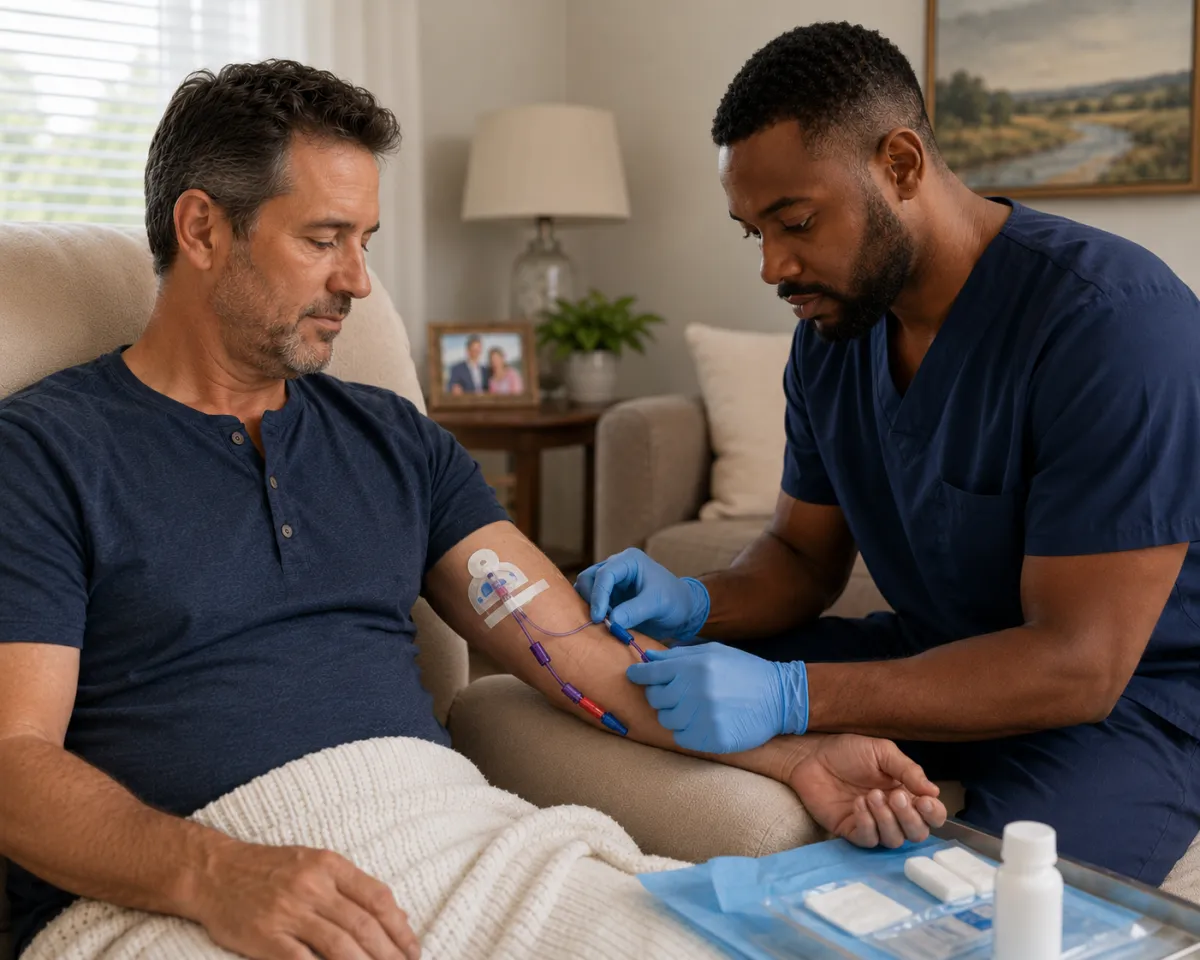
PICC Line Care at Home: What Patients Need to Know
Your PICC Line Is In — Now What?
A PICC line (Peripherally Inserted Central Catheter) is one of the most common forms of IV access used for home infusion therapy. Whether you're receiving antibiotics, biologics, or nutritional support, proper PICC line care at home is essential — both to protect the line itself and to prevent serious complications like infection or clotting.
At Gulfside Living Healthcare Services, we are a Florida Licensed Nurse Registry, AHCA License #30213171. We connect patients in Southwest Florida with experienced independent contractor nurses who are trained in PICC line care and monitoring.
Here's what every patient and caregiver should know.
What Is a PICC Line?
A PICC line is a long, thin, flexible tube inserted through a vein in your upper arm and threaded until the tip sits near your heart in a large central vein. Because it accesses a central vein, medications delivered through a PICC reach the bloodstream quickly and can be given over weeks or months without repeated needle sticks.
PICC lines are used for:
Long-course IV antibiotics (OPAT therapy)
Chemotherapy
Biologic medications
Total Parenteral Nutrition (TPN)
IV hydration or medications that cannot be given through a peripheral IV
Daily PICC Line Care: What Your Nurse Will Do
Each time your home infusion nurse visits, they will assess and care for your PICC line. This typically includes:
Site inspection — checking for redness, swelling, warmth, drainage, or tenderness at the insertion site
Dressing change — replacing the sterile dressing using a no-touch technique, usually every 7 days or sooner if the dressing is wet, loose, or soiled
Flushing — flushing the line with saline (and heparin if required) before and after each infusion to keep the line clear and prevent clotting
Cap change — replacing the needleless connector (cap) on a regular schedule to reduce infection risk
Documentation — recording the condition of the site and any observations in your care record
What You Should Watch For at Home
Between nurse visits, you and your caregiver should monitor for warning signs. Contact your nurse or go to the emergency room immediately if you notice:
Redness, warmth, or swelling at the insertion site or along the arm
Discharge, pus, or bleeding from the site
Fever over 100.4°F (38°C) — this can be a sign of a line infection
The line appears to have moved (more or less visible outside the skin than before)
The line is not flushing smoothly or feels blocked
Chest pain or shortness of breath (call 911 immediately)
Arm swelling above or below the insertion site — can indicate a clot (DVT)
Protecting Your PICC Line Between Visits
Patients and caregivers can take several steps to protect the PICC line between nurse visits:
Keep the dressing dry. Use a waterproof PICC cover or plastic wrap secured with tape when showering. Do not submerge the arm in a bathtub, pool, or hot tub.
Avoid heavy lifting. Lifting more than 10 pounds with the arm that has the PICC can dislodge the line or cause complications.
Don't bend or kink the line. Avoid tight clothing over the PICC site and be careful when dressing or reaching overhead.
Secure the line. Use the securement device or stat-lock provided and keep the line looped and taped to your arm — never let it dangle freely.
Don't use that arm for blood draws or blood pressure. Notify any healthcare provider about your PICC before they take vitals.
When to Call — Don't Wait
A PICC line infection (CLABSI — Central Line-Associated Bloodstream Infection) is a serious, potentially life-threatening complication. When in doubt, call. Early intervention prevents hospitalizations. Your infusion nurse will give you a contact number and clear instructions for who to reach at any hour.
What About Ports and Midlines?
PICC lines are the most common form of home infusion access, but some patients use an implanted port (under the skin, accessed with a special needle) or a midline catheter (shorter than a PICC, used for shorter courses of therapy). Care principles are similar but specific protocols vary — your nurse will be trained in whichever access device you have.
Southwest Florida Home Infusion Nursing
Gulfside Living Healthcare Services serves Collier, Lee, Charlotte, Sarasota, DeSoto, Glades, and Hendry Counties. We connect patients and healthcare providers with qualified independent contractor RNs and LPNs experienced in PICC line care, IV therapy, and home infusion management.
We are a Florida Licensed Nurse Registry, AHCA License #30213171. For referral source inquiries, contact us at (941) 248-3816.
